
The real heroes of Operation Sindoor were not the armed forces or political leadership, but the ordinary citizens of India who refused to fall into the trap of communal provocation, asserts Colonel Anil A Athale (retd).
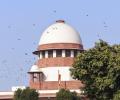
The Indian government defended the Waqf (Amendment) Act, 2025 in the Supreme Court, arguing that waqf, while an Islamic concept, is not an essential part of Islam. Solicitor General Tushar Mehta stated that waqf is essentially charity, which is recognized across religions, and cannot be considered a fundamental tenet of any faith. He also argued that the amended law addresses secular aspects of waqf and activities unrelated to Islam, and that "waqf by user" does not grant ownership of public land. Mehta highlighted the extensive consultations involved in the bill's creation, including feedback from various stakeholders. The hearing will continue on Thursday.

The Central Administrative Tribunal (CAT) has overturned the Karnataka government's suspension of IPS officer Vikash Kumar Vikash, who was suspended following a fatal stampede at a stadium last month. The tribunal's decision could also lead to the reinstatement of other suspended officers.

India's decadal census is likely to be further delayed after the budget allocated only Rs 574.80 crore for the exercise, a significant reduction from previous years. The census, originally scheduled for 2021, has been postponed due to the COVID-19 pandemic, and the government has not yet announced a new schedule. The budget allocation suggests that the exercise may not be carried out even after the delay. The upcoming census will be the first digital census, allowing citizens to self-enumerate using a dedicated portal. The exercise will be made compulsory for citizens who wish to self-enumerate, and Aadhaar or mobile numbers will be required. The census will include questions on household demographics, amenities, and economic status.

'Although China has been ruling over Tibet for past 75 years, it has no legitimacy.'

Uttarakhand Chief Minister Pushkar Singh Dhami has announced that the state will become the first in independent India to implement the Uniform Civil Code (UCC), with the date of implementation to be announced soon. The UCC, which aims to unify personal laws for all citizens, has been approved by the state cabinet and preparations for its implementation are almost complete. Dhami stated that the training process for UCC implementation is nearly finalized and the government is aiming for a swift rollout. Speculation is rife that the UCC could be implemented on Republic Day, coinciding with the conclusion of municipal elections. The UCC includes provisions related to marriage, divorce, annulment of marriage, succession, and live-in relationships. The state government has introduced a dedicated portal for online registration of related matters and has authorized Common Service Centers (CSC) to simplify access for citizens. In remote areas, CSC agents will provide door-to-door services. The Gram Panchayat Development Officer will serve as the Sub-Registrar for registration work in rural areas. The government has also implemented Aadhaar-based registration to make the process easier. Citizens can track their application status through email and SMS, and an online complaint portal has been set up. Dhami dismissed Congress allegations of divisive politics, emphasizing that the UCC provides a uniform system and law for all.

He said one has to respect rights of all our citizens, regardless of ethnicity, language or creed.
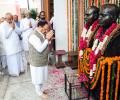
'As we read and assess what is going on around us in the India of 2025, it is instructive to do this through the lens of 75 years ago and the events that led to the formation of the BJP as we know it,' recalls Aakar Patel.
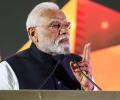
Prime Minister Narendra Modi hailed the passage of the Waqf (Amendment) Bill in Parliament as a "watershed moment" in the country's quest for socio-economic justice, transparency and inclusive growth. He said the legislation will particularly help those who have long remained on the margins, thus being denied both voice and opportunity. Modi stated that the Waqf system was synonymous with lack of transparency and accountability, especially harming Muslim women, poor Muslims and Pasmanda Muslims. He added that the legislation will boost transparency and safeguard people's rights, ushering in a more modern and socially just framework. The prime minister thanked all members of Parliament and the public for their contributions to the legislation.

Khan said the events of May 9, 2023, in which military installations were targeted, were in fact a part of the "London Plan"- the sole purpose of which was to "eliminate Pakistan's largest political force, the Pakistan Tehreek-e-Insaf".
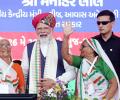
'The country that came into existence after Partition lives on hatred for India. It only wants to harm Bharat. However, India's goals are to remove poverty, bring about economic development and become a developed nation'

No foreign entity or government has any locus standi to comment on the fundamental rights of Indian citizens, the government said on Thursday, rejecting a report by the US state department on the alleged curtailment of religious freedom in India.

'The retail industry is still growing in double digits.'

'The next decade will be even more transformative,' says Prime Minister Modi. 'We are moving from digital governance to global digital leadership.'

About 57 per cent of Indian districts, home to 76 per cent of the country's population, are currently at high to very high risk from extreme heat.

Lieutenant General Shakti Gurung deserves to be complimented in telling his life story and that of his people, as subaltern communities within this vast and diverse nation of ours clamour for recognition and a plea for their voices to be heard and their aspirations to be met, notes Lieutenant General Gautam Moorthy.

The Bombay high court on Friday quashed the amended Information Technology rules aimed at identifying through a fact checking unit "fake and false" content against the government on social media platforms, holding it as unconstitutional.

Congress MP Shashi Tharoor has condemned the manner in which Indians staying illegally in the US were deported, calling it an 'insult to India and the dignity of Indians'. He urged the Indian government to issue a message to the US, making it clear that it has no right to deport people in such an 'insulting manner'. Tharoor also pointed out that Colombia had previously refused to accept suspected immigrants of Colombian origin under similar circumstances, officially protesting when people were sent back in handcuffs. He demanded an explanation for the 'atrocious behavior' from the US government.

A delegation of a Meitei civil society group from Manipur has conveyed its concerns to the Centre over an incident where the state's name written on a bus windshield was covered with white paper. The group, Coordinating Committee on Manipur Integrity (COCOMI), expressed its commitment to peace and its willingness to cooperate in efforts to restore normalcy. They also raised concerns over the growing threats posed by narco-terrorism, cross border illegal immigration, and widespread illegal opium cultivation in the state.
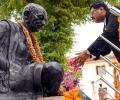
Justice Bhushan Ramkrishna Gavai, India's 52nd chief justice and its first Buddhist one, has played a key role in shaping the judicial landscape, penning about 300 verdicts, including landmark rulings on constitutional issues, liberty, and perhaps most important against the executive's 'bulldozer justice'.
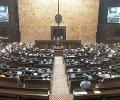
The Waqf (Amendment) Bill, 2025 was passed in the Lok Sabha early Thursday, with 288 members supporting it and 232 against it.

The Supreme Court of India has repeatedly criticized the Enforcement Directorate (ED) for exceeding its authority and misusing its powers. The latest rebuke came on Thursday, when the court accused the agency of 'crossing all limits' in a money laundering probe against a Tamil Nadu state-run liquor retailer. This follows a string of similar observations by the Supreme Court and high courts across India, raising concerns about the ED's investigative practices and the potential for misuse of its powers.
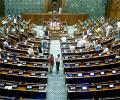
The legislation is aimed at streamlining various services related to immigration and foreigners, including their entry, exit and stay in India.

India on Friday called on the International Monetary Fund (IMF) to reconsider its $1 billion assistance to Pakistan, suggesting that Islamabad could use it for terror funding.

Kashmir tourism is staring at a loss of Rs 2000 crore with tourists pulling out in droves post the Pahalgam terror attack, and travel agents are pinning their hopes on social media by actors reverses the trend and brings back tourists to the Union territory.
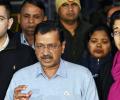
'A government whose policies are focused around making the life of ordinary citizens, specially the most deprived sections, richer; a government that prioritises education, health and transport, that doesn't treat its citizens as subjects who must come to it for everything, is rare in our country.' 'When such a government is thrown out, one is left stunned,' notes Jyoti Punwani.

An apex body of psychiatrists in India has said members of the LGBTQA community should be treated like all citizens of the country and have access to marriage, adoption, education, employment, property rights and healthcare.
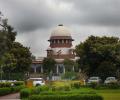
The Supreme Court of India will likely hear a batch of petitions challenging the constitutional validity of the Waqf (Amendment) Act, 2025 on April 15. The Act, which came into force on April 8, has been met with widespread criticism from various stakeholders, including politicians, the All India Muslim Personal Law Board (AIMPLB), and Jamiat Ulama-i-Hind. They argue that the law is discriminatory and violates the fundamental rights guaranteed under Articles 25 and 26 of the Constitution. The petitions allege that the amendments give the government more control over the administration of Waqf, effectively sidelining the Muslim minority from managing their own religious endowments.

This might help explain why our global outreach has received such a tepid response. We have chosen to be transactional with the world, as our UN votes reveal, points out Aakar Patel.
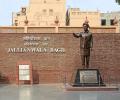
Former Supreme Court judge Justice Rohinton Nariman has warned that events similar to the Jallianwala Bagh massacre could occur if the 'basic structure' doctrine of the Constitution is diluted. In his new book, 'The Basic Structure Doctrine: Protector of Constitutional Integrity,' Nariman argues that the 1973 Kesavananda Bharati judgment, which established the doctrine, is essential for protecting fundamental rights and preventing constitutional amendments that could lead to such tragedies. Nariman's concerns are echoed by Supreme Court judge Justice K V Viswanathan, who applauds the book for its "chilling clarity" and underscores the importance of the Kesavananda Bharati ruling. The book provides a detailed analysis of the doctrine and its implications, highlighting the robustness of the Kesavananda Bharati judgment and the lack of a compelling alternative theory.

A three-judge Supreme Court bench will hear petitions challenging the constitutional validity of the Waqf (Amendment) Act, 2025, on April 16. The petitions, including those by politicians and the All India Muslim Personal Law Board (AIMPLB) and Jamiat Ulama-i-Hind, were filed in the top court challenging the validity of the newly-enacted law. The Centre has filed a caveat in the apex court, seeking a hearing before any order is passed.

Underscoring the 'presumption of constitutionality in favour of law', the Supreme Court on Tuesday said petitioners challenging the waqf law needed a 'strong and glaring' case for interim relief.

Deposed Bangladesh Prime Minister Sheikh Hasina has issued a strong warning against threats to ban her Awami League party, calling the demands "audacious" and accusing Nobel laureate Professor Muhammad Yunus of being a "fraud" and "corrupt" for his role in the current interim government. Hasina, who fled Bangladesh in August 2024 following a student-led uprising, claims Yunus assumed power through a "meticulous design" with funding from overseas and misled students and people. She asserts that her Awami League is the legitimate party, with a strong history of fighting for the people's rights, and accuses Yunus and his supporters of having no constitutional basis or people's mandate to rule the country.

In an interaction with naval warriors on board aircraft carrier INS Vikrant off Goa, Singh sent a stern warning to Islamabad saying India will not hesitate to use the methods to deal with terrorism that Pakistan cannot even think of.

The Jammu and Kashmir Students Association reported receiving over 1,000 distress calls from students across the country, many expressing fears for their safety and making urgent plans to return home.

Indian students at Harvard, on condition of anonymity, shared their concerns and experiences of the last few months during which the prestigious university has seen relentless attacks by the Trump administration.
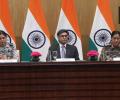
"It is shocking to note that Turkey, the second-largest arms supplier to Pakistan after China, has played a key role in modernising Pakistan's navy and enhancing its aerial warfare capabilities. "This defence collaboration is not just commercial; it is ideological, targeting the stability of South Asia and emboldening Pakistan's military adventurism," SJM national co-convenor Ashwini Mahajan said in a statement.

President Donald Trump has announced that the United States will introduce a 'gold card' for wealthy foreigners, granting them the right to live and work in the country, with a pathway to citizenship, in exchange for a $5 million fee, CNN reported.

Despite ongoing tension between the two countries on the issue of extremism, Bezirgan said he expects warmer ties henceforth as Carney has invited Prime Minister Modi for the G7 Summit.

Union Home Minister Amit Shah on Thursday vowed to hunt down each and every terrorist involved in the Pahalgam attack and said all of them will be made answerable for the heinous act.
